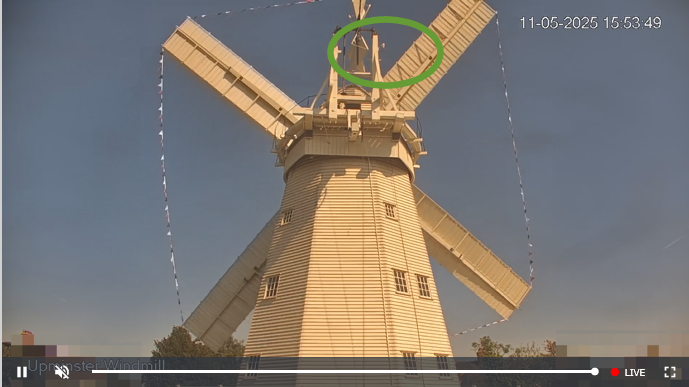
The height of the anemometer (wind speed and direction) is around
25m from the road level (gallery: 9m + space gallery and sail: 1m
+ sail length:12m + flagpole: 3m) and some 28m from the river's
floodplain level.
Rijn en Lek is in a very open environment (certainly at shaft
height). The trees at the castle Duurstede estate in the west and
the two churches in the NNW can have influence. The rest is very
open in a large portion of the wind rose (N to SW), and will have
a likely z0m=0.03m (the river-delta), while the rest
(town direction) might be z0m=0.5m or 1m.

A panorama picture made by Justin Coombs ((c) 2024)
Alignment error
Photometric method
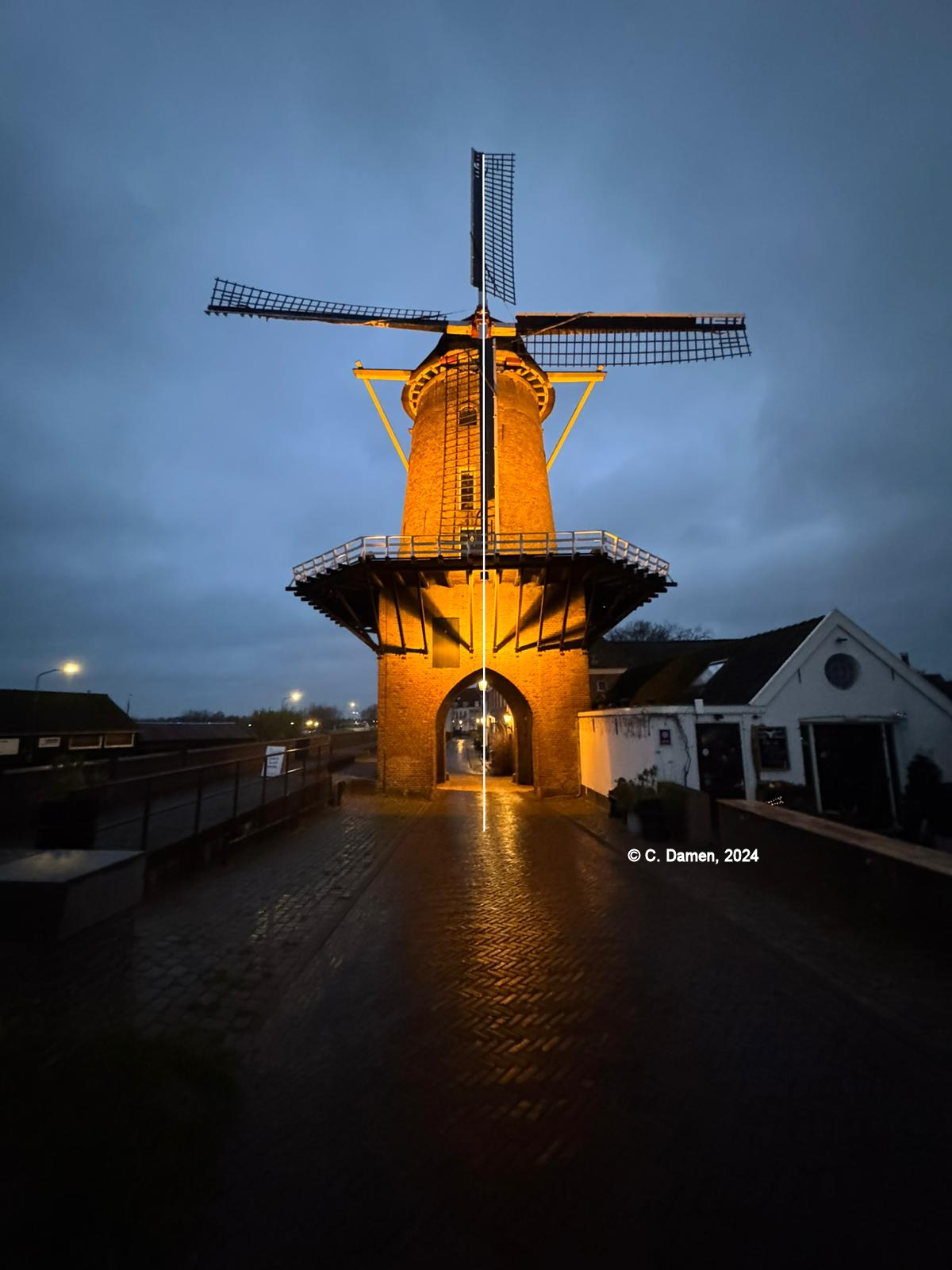
The following photograph (made on 10/12/2024) is being used to check
the mill cap's orientation reported by the magnetometers:
In the above photo the stock looks to be vertically positioned above
the middle of a gallery sector. The plumb (white) line looks
to be in the middle of the road (as the mill was positioned on a
gate, it is logical the road would be in this way).
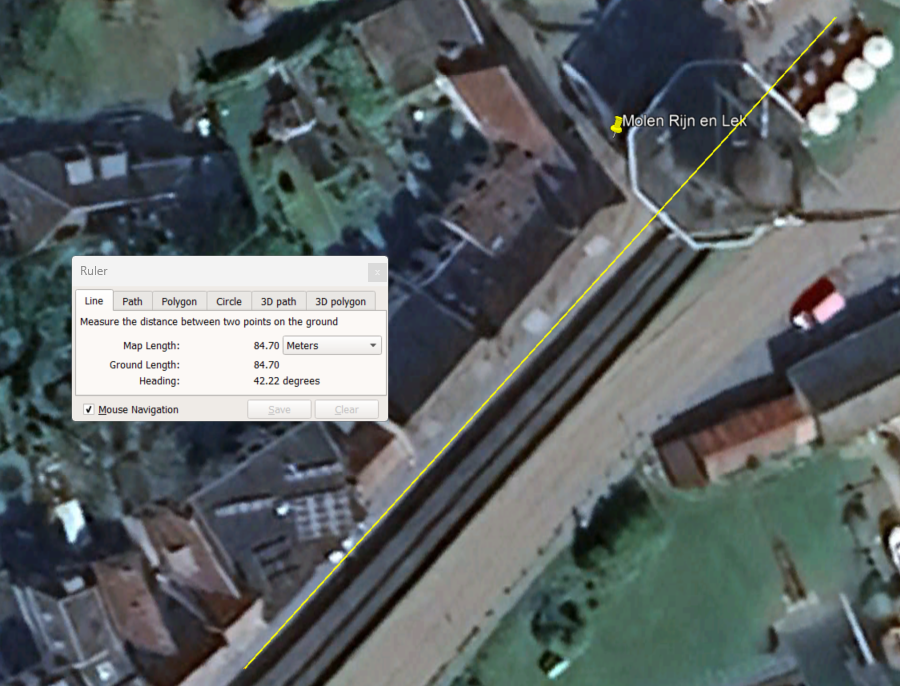
Looking at Google Earth, the direction of the road is around 42deg:
The sensor measurement at the time of the photo was around 33.5deg. So the sensor direction readings need to be
aligned by increasing it with 8.5deg, to align with the real
direction.
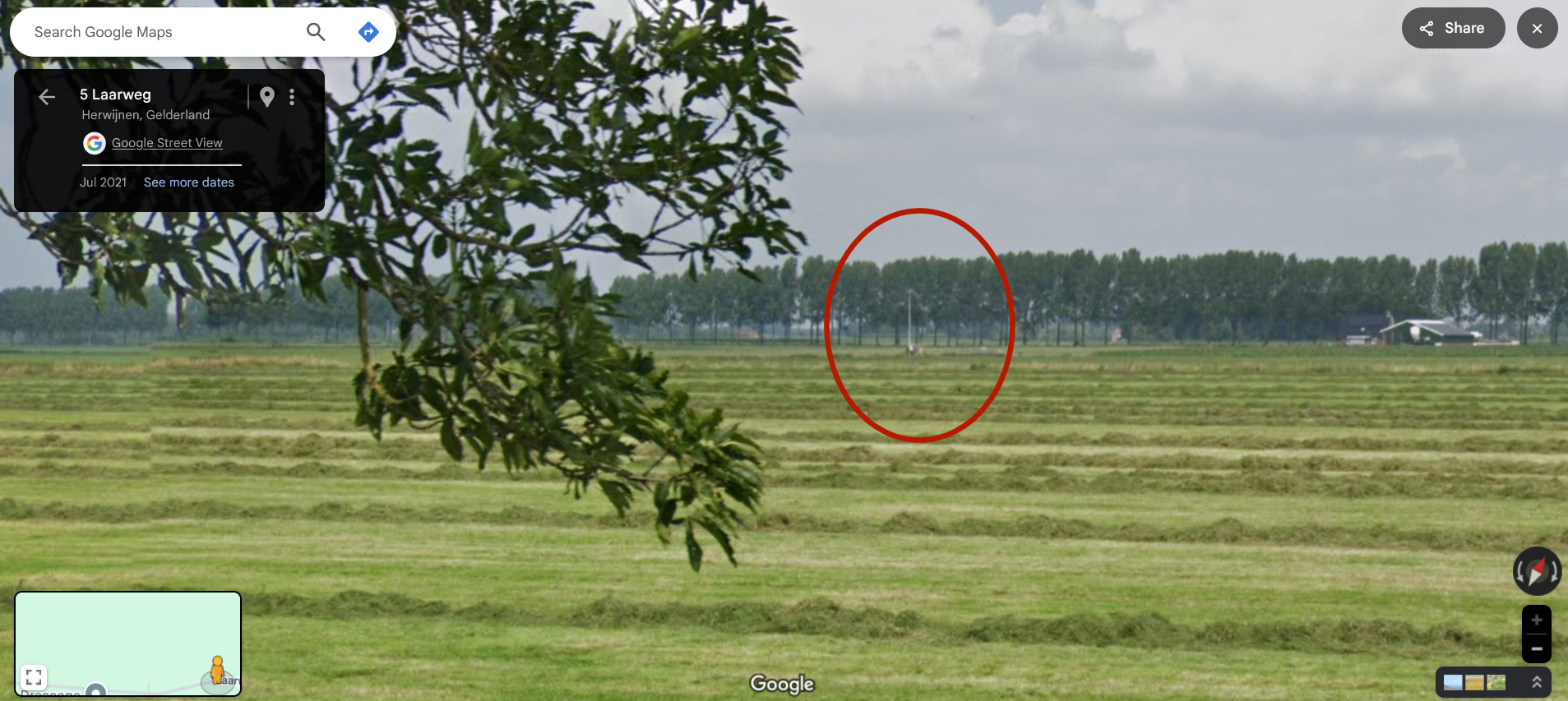
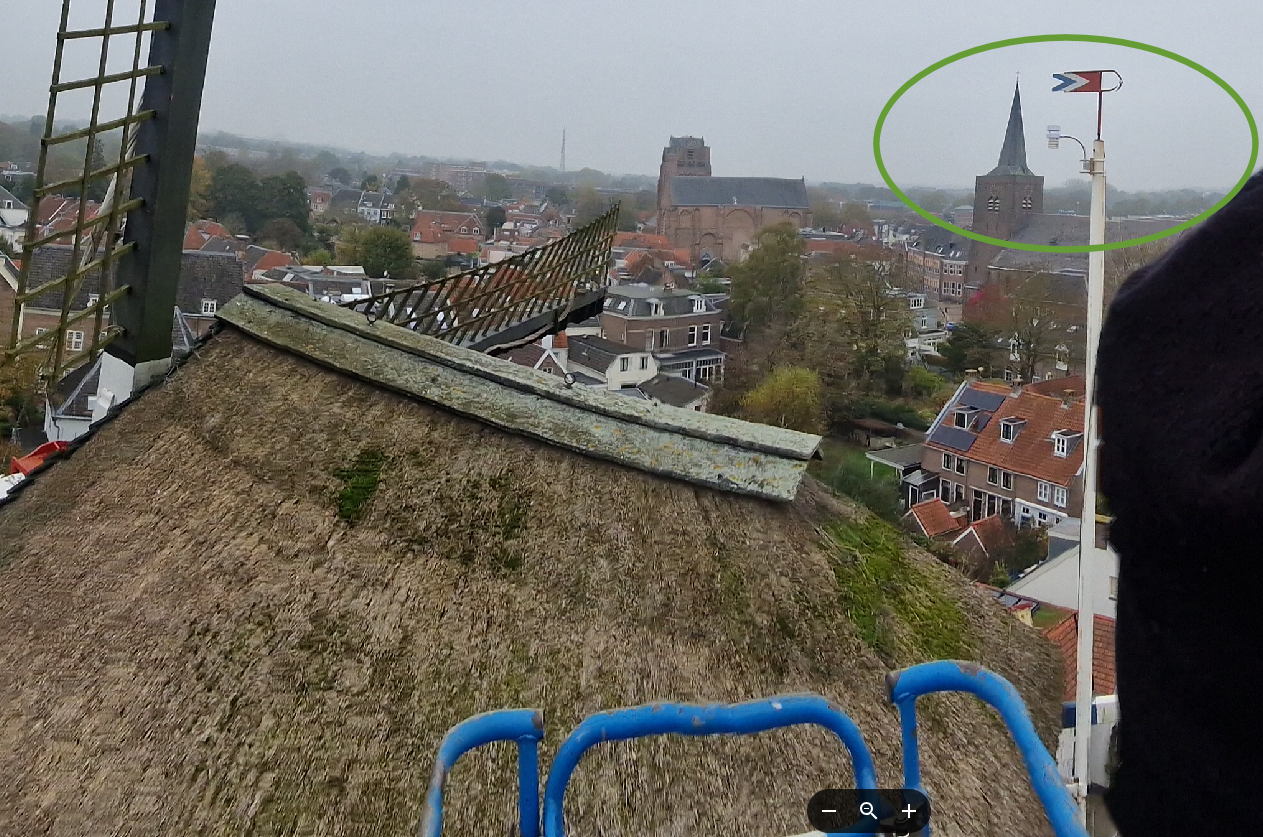
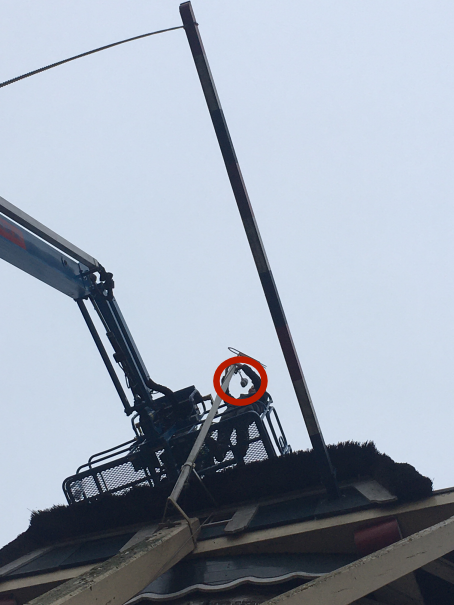
Herwijnen AWS is in a flat river-delta environment, although there
are trees some 250 and 400m distance along the roads, see here (the pole in the red circle):
Roughness length (z0) a
HERW
KNMI-Cabauw stands in between rough environment [Davenport,
2000]. So a likely z0=0.25m.
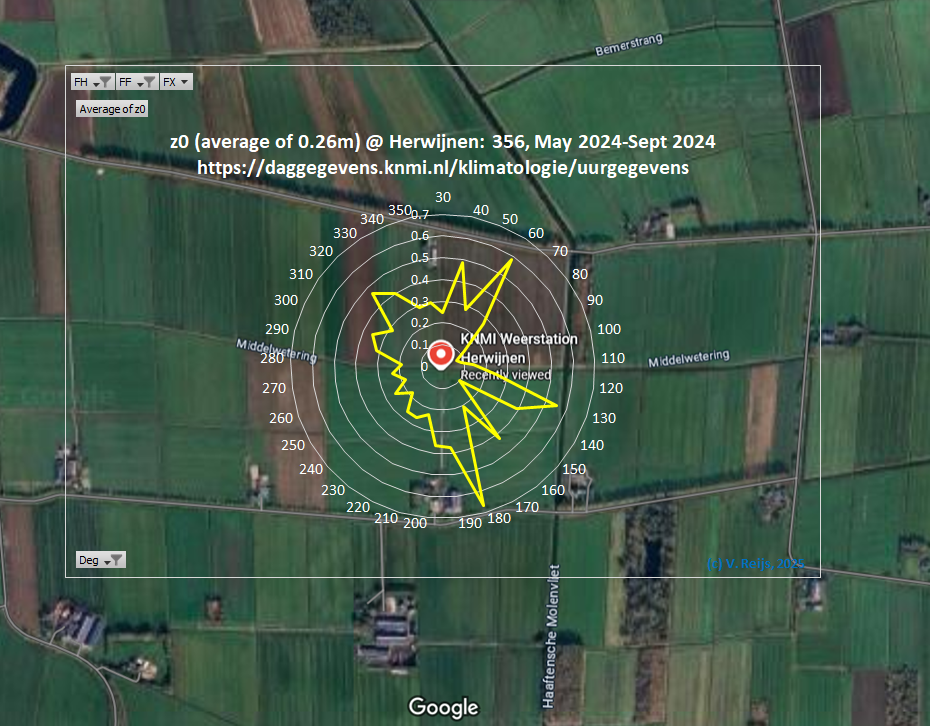
Using wind and gust speeds (hour averaged) at
Herwijnen [Benschop 2005b Chapter 1] we get an z0
with an average around 0.26m (during leafed period:
May-September):
Wind speed
The average wind speed over the year can be used to normalise the
meteorological stations' wind speed towards the Wijk bij Duurstede
location:
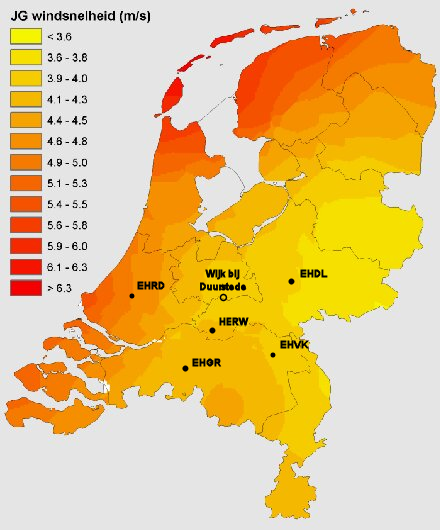
The yearly average wind speeds are [m/sec]:
As the wind speed is referenced to a height of 10m, we need to
determine the speed at the mill's anemometer height (which is 25m)
to be able to compare like with like.
It is assumed the roughness length at meteorological stations is z0a=0.24m
and assuming the roughness length at the mill's anemometer is z0m=0.39m. The speed at anemometer height (25m) will
have an additional increase of [Beljaars, 1979, page 4]:
ushaft=u10*(ln(60/0.24)/ln(10/0.24))/(ln(25/0.39)/ln(60/0.39))
= u10* 1.22
Remark: The z0m
is not really known as there might not exist an logarithmic
ABL at the mill (now used a z0m=0.39m).
Wind direction
The average wind direction over the summer (red / black arrows)
and winter (blue) can be used to normalise the meteorological
station's wind direction towards the Wijk bij Duurstede location:
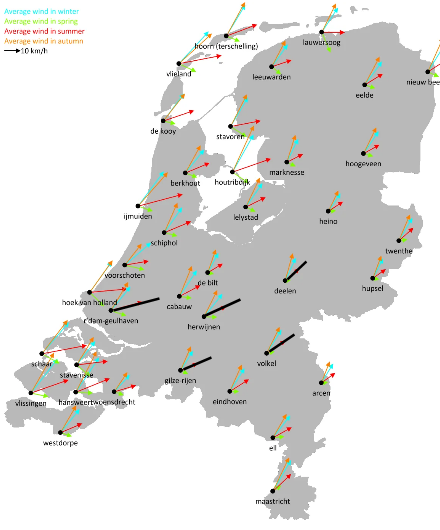
The average wind directions are [deg]:
Wijk
bij
Duurstede
EHDL
HERW
Summer direction [deg]
245
227
246
Normalise summer
direction [deg]
0
+18
-1
Winter direction [deg]
218
203
219
Normalise winter
direction [deg]
0
+15
-1
Sanitising the smartmolen database
The opendata database for Rijn en
Lek is here: https://api.smartmolen.com/export/csv/summarised/rijnenlek/2024-01-01/2026-01-01/60
The mill (rijnenlek) can be changed to other mills in
smartmolen; the first date (2024-01-01) is the start date
from which one wants the data; the second date (2026-01-01)
is the end date; and the interval (60) is the interval [in
minutes] over which the data is averaged.
A few things are selected from the dataset of the smartmolen
database:
rows with a wind speed below 1.5m/sec (1Bft) and higher than
13.9m/sec (7Bft) are removed
rows that have an MILL_ORIENTATION_CONFIDENCE of lower than 20
are removed
remove rows with an absolute direction angle difference
between Rijn en Lek and meteorolocal station of larger than 90
degrees.
between 6/12/2024 10:00 and 7/12/2024 10:00 the anemometer
speed was constantly 2.3m/sec and direction around 296deg (see
also below speed
graph and in the green circle of this graph). These
were also removed.
This happened gain in april 2025. New firmware would be needed
in the weather station, but we would need a cherry picker to
install it using an USB cable. The software of smartmolen has
been updated, so it recognises this fault.
Include HERW data.
Analysis of the measurements
Comparing with Rijn en Lek
To compare meteorological station's speeds (EHDL and HERW) with Rijn
en Lek anemometer speeds, we might need to use IDW or another
methodology [Apaydin, 2004].
Remark: Perhaps using the above average speed and direction is
coming close to ordinary kriging (KO), but not sure! Or use
Open-Meteo.
In below no IDW or KO is used, just individual
meteorological stations are being used.
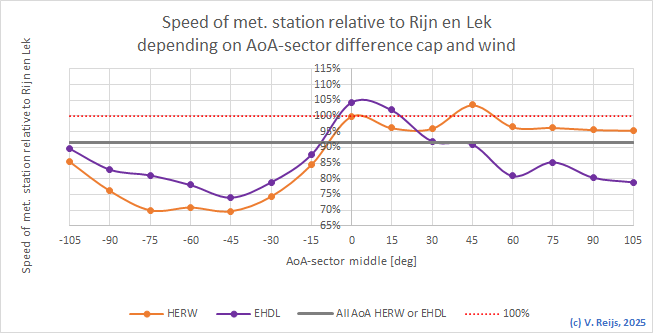
Wind speeds
The wind direction of the meteorological stations can be seen
below with the wind direction at Rijn en Lek mill on the x-axis
(for 1Bft upto and including 7Bft). The meteorological station's
speeds have been compensated for the height of the anemometer and normalised
with the average
yearly wind speed.
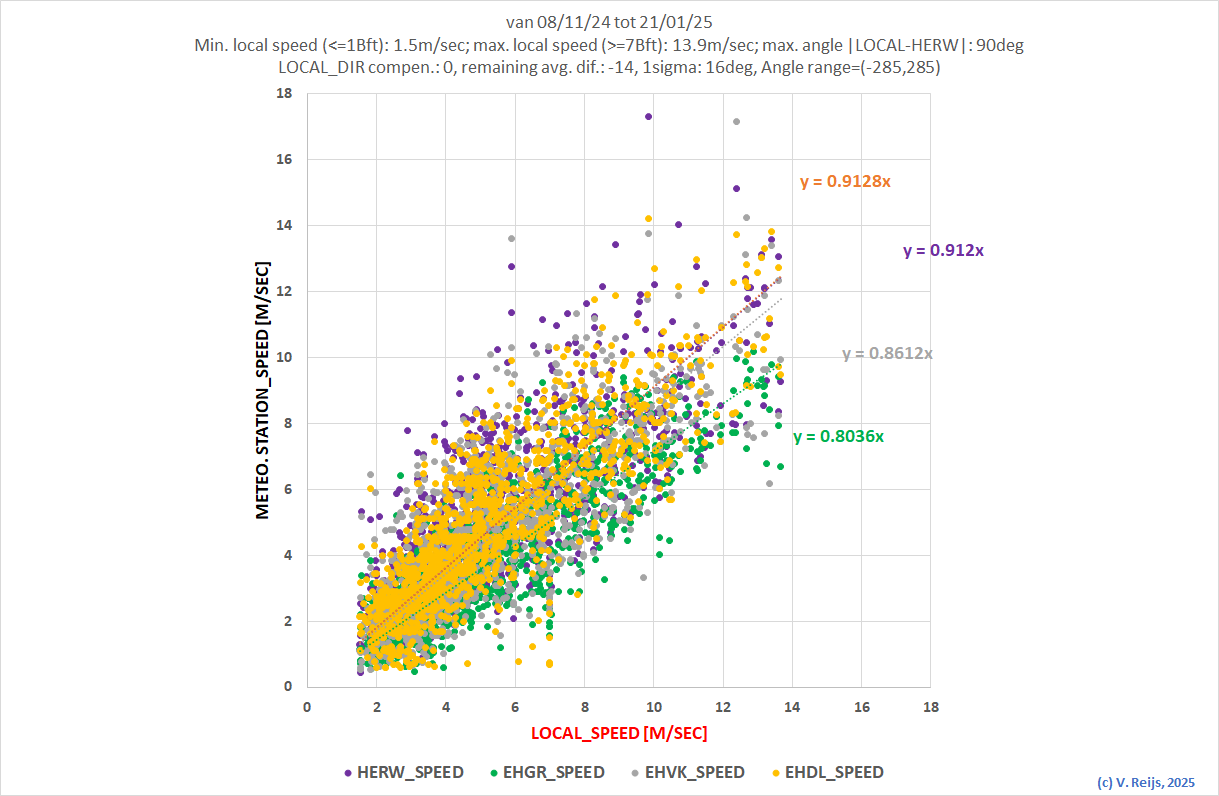
Speed comparison at the mill cap
Expectations
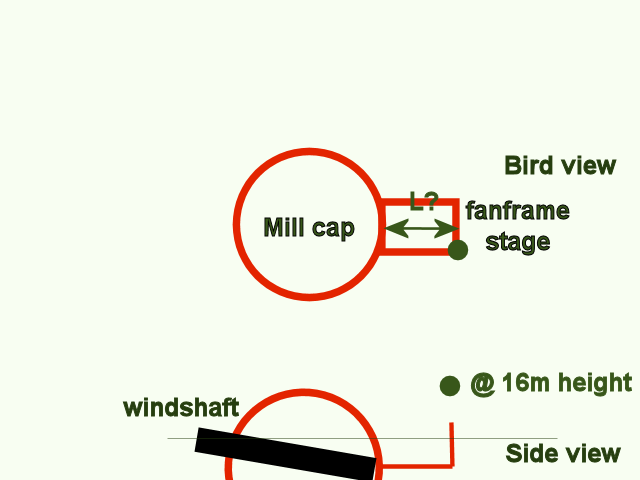
What is to be expected when looking at the wind speed effects
around the anemometer, which is 2m above the mill cap and some
25cm in front of the flagpole?
The wake of the cap will have influence, by increasing or
decreasing the windspeed at the anemometer. The following effects
could happen (negative angle of attack [AoA] means a backed wind
and positive AoA means veered wind):
If the wind comes from the back (AoA lower -150 or higher
than150deg).
It is expected that the wind speed of the meteorological station
will be similar (close to 100%) to the anemometer's if wind is
from the NNE to SSW; or the meteorological station's could be
higher than the anemometer's if the wind comes over the town
(SSW to NNE).
This situation is not happening in reality a lot. In the below
analysis this could not be checked, as there were not enough
measurements for this situation.
If the wind comes from the front (AoA between -30 and 30deg).
It is expected that the wind speeds of the meteorological
station will be higher or smaller than at the anemometer's if
wind is from the NNE to SSW. The higher or smaller depends on
the effect of the wake due to the mill cap (see also). The
meteorological station's speed would likely be higher than the
anemometer's if the wind comes over the town (SSW to NNE).
This situation happens a lot.
If the wind comes from the side (AoA between -45 and -135deg
or between 45 and 135deg).
This will have an in between effect of the earlier two bullets.
This situation happens a lot between 45 and 105deg or -45 and
-105deg. In the below analysis angles outside this range could
not be checked, as there were not enough measurements for that
range.
Evaluation
From above graph it shows that the averaged wind speed of the
meteorological station (HERW: purple dots) is close to the speed at
Rijn en Lek (LOCAL). A few possible phenomenon need to be kept in mind when
comparing:
The utilised z0 for the mill and the meterological
statiosn need to be as close as possible to reality.
The recommendation for meteorogical stations is in general z0<0.5m
[Benschop, 2005, chapter 3], the
z0 for HERW was determined using this method,
and was around 0.26m.
The z0 of the mill shoudl also be determined
using the anemometer measured on the mill.
A more specific z0m in a certain direction from
Rijn en Lek (say between 0.05 and 1m) could be considered.
The South to West sector (most winds are from that
direction) is from floodplains of Rijn en Lek rivers. So
perhaps the z0m is closer to 0.03m (Open flat
terrain) for those directions
The floodplains are lower than road level, some 3m lower. This
increases the wind speed (at 28m) at the meteorological station.
Would wind channeling (due to churches) cause a high
SpeedFactor for Rijn en Lek?
The anemometer might be in the wake of the
mill cap; this would introduce a higher or lower wind speed,
depending where the anemometer is in the wake.
Rijn en Lek's anemometer is at a height of 1.09*Hcap,
it is not 100% sure what would happen at this height, will it reduce
or increase the wind speed. To be verified with a CFD of the
mill-body.
Wind direction
The relative wind direction of the meteorological
stations can be seen below (relative to the wind direction at Rijn
en Lek mill). The meteorological station's directions have been
compensated for the average winds direction in winter.
Rijn en Lek wind direction (on x-axis) has been compensated for
the alignment error.
The distribution of directions can be seen below:
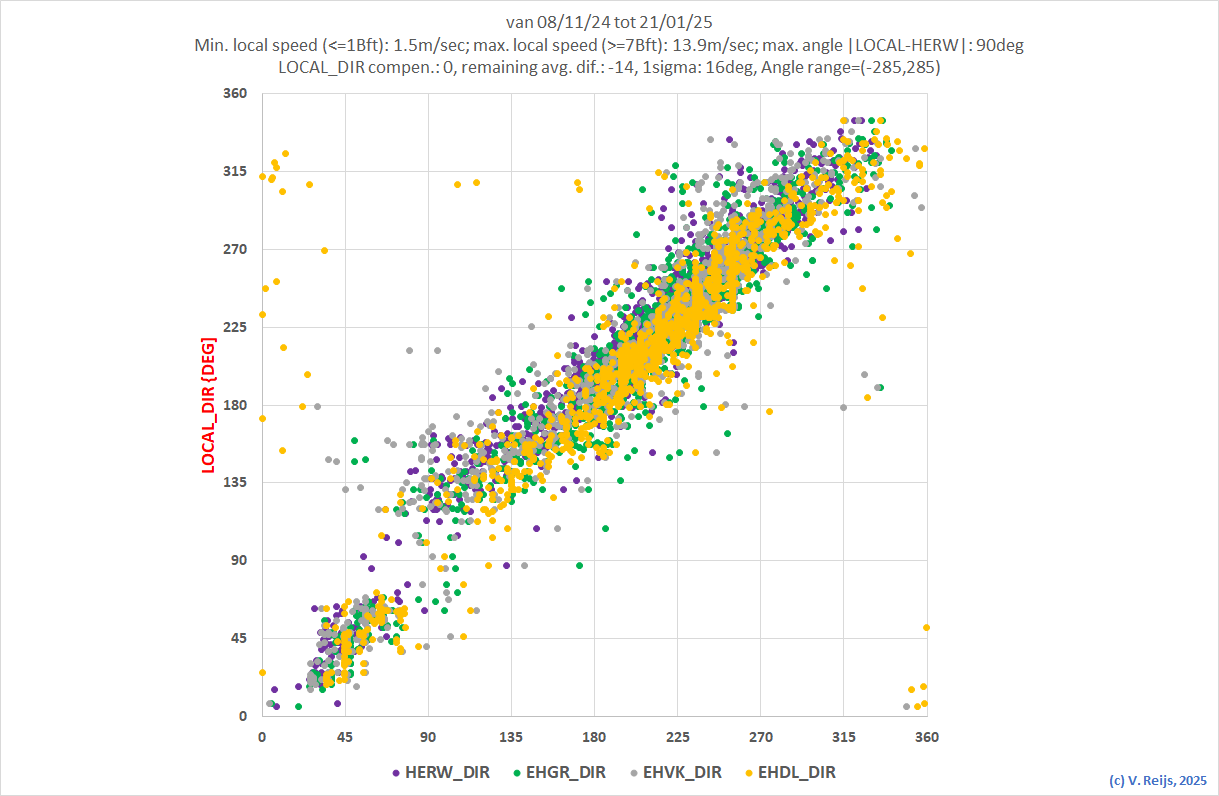
The standard deviation of relative meteorological
stations' direction is some 25deg. Assuming that the standard
deviation of the meteorological stations' and anemometer's wind
direction are similar, they are both around 15deg.
Changing mill cap direction
From 24/11/2024 05:00 until
25/11/2024 01:00 one sees a slowly moving direction of the mill
cap (from 198 to 204deg), while no manual turning happened (in the
red circle):
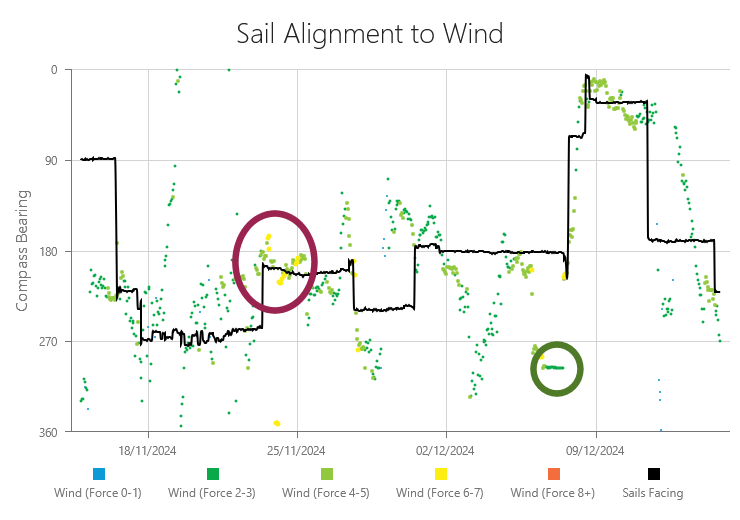
This is at the time that storm Bert
(in particular its warm sector) raged over The Netherlands.
Explanation could be: a) the cap was
pushed to the side of the curb due to the wind force or b) the
magnetometer calibration process caused this.
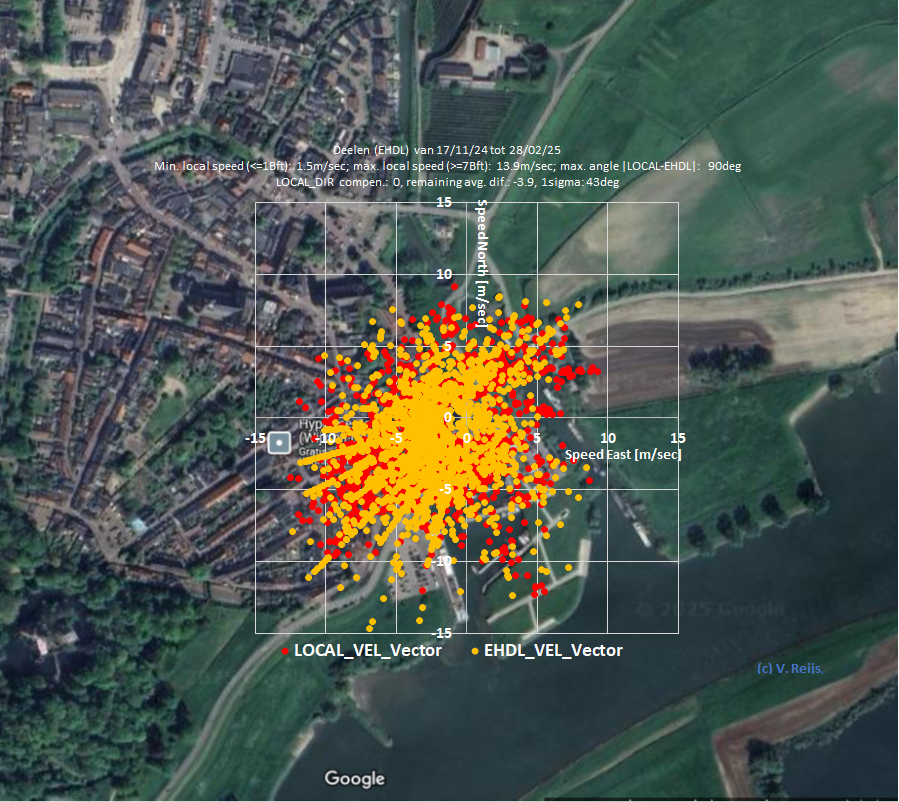
Wind distribution seen over town
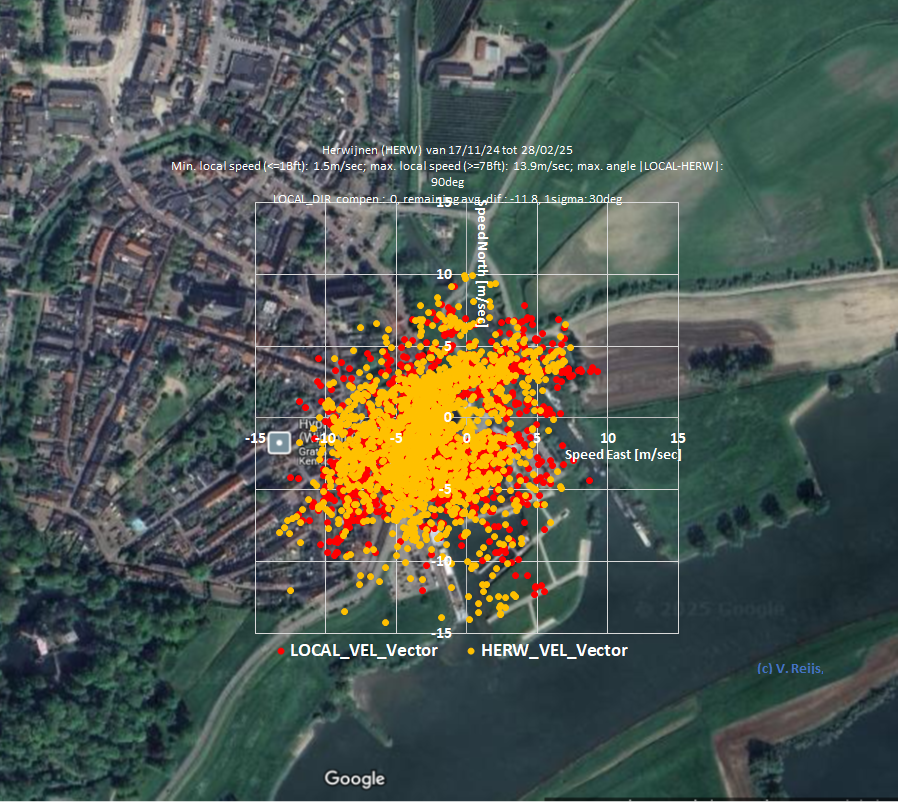
KNMI meteorological stations Deelen and Herwijnen (orange dots,
looks that the majority has a resolution of some 5deg) has been
used below, as these two have the smallest difference with wind
direction at Rijn en Lek (red dots, 1deg resolution) and they are
close meteorological stations to Rijn en Lek.
Herwijnen,
HERW
Deelen,
EHDL
The looks to be some realistic mapping between Rijn en Lek
(LOCAL), Deelen (EHDL) and Herwijnen (HERW).
Matching mill anemometer readings with
calculations
Rijn en Lek
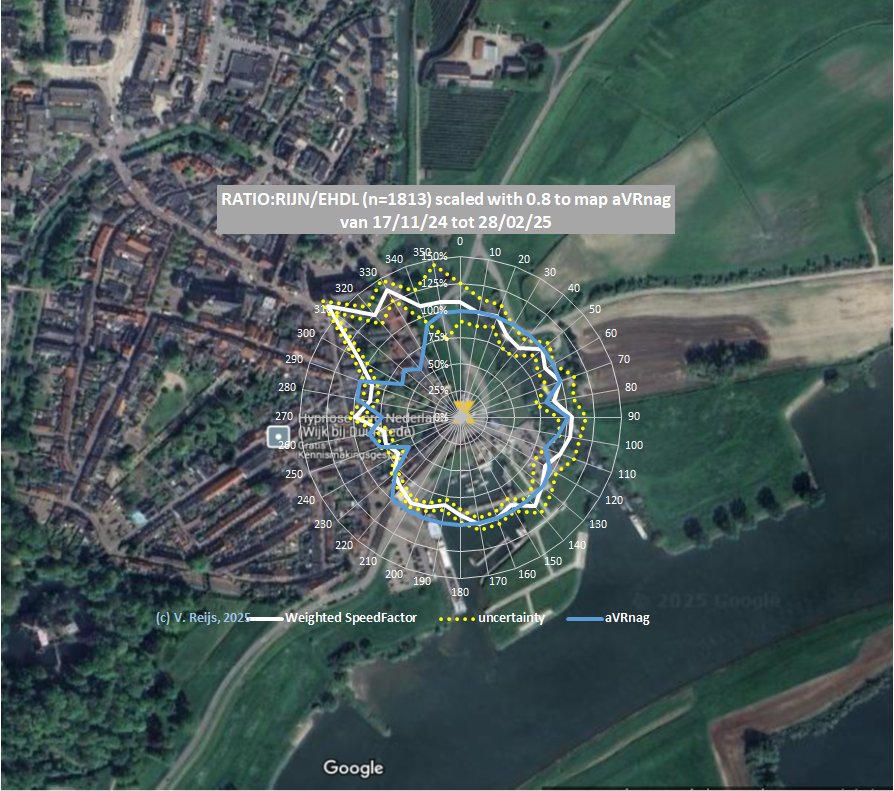
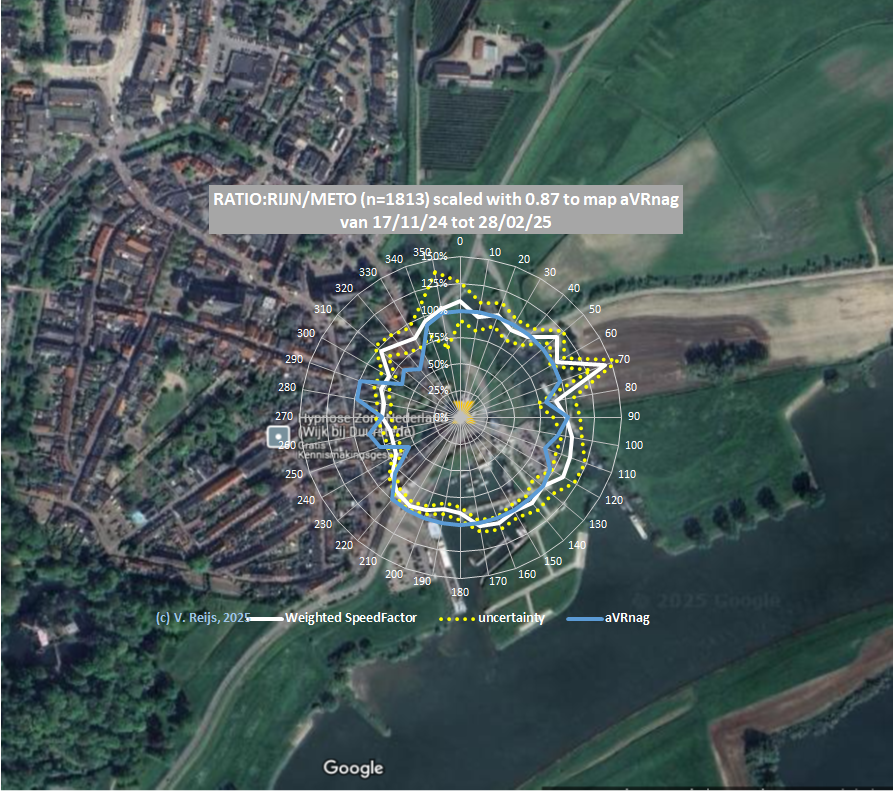
The above compensated direction and wind speed data have been
used. The speedfactor has been derived by dividing the Rijn en Lek (LOCAL) anemometer's wind
vector by the meteorological (HERW or EHDL) station's wind vector.
From these, the (non-weighted) average speedfactor magnitude per
10deg sector has been derived.
<right click a picture, to see a larger version in another
browser window>
Rijn en
Lek&HERW
Rijn en
Lek&EHDL
Rijn en
Lek&Open-Meteo
Looking at the anemometer measurements
Mesurements are for the period 8 November 2024 to 13 March
2025, so winter time (November upto and
including March). The trees are leaveless.
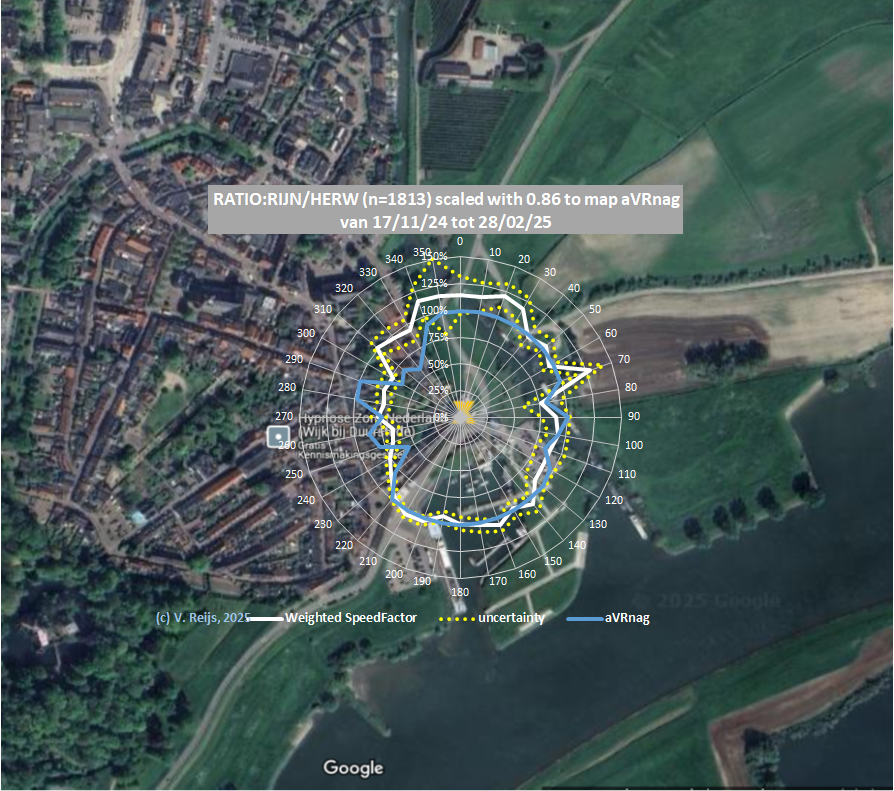
It looks that the anemometer speeds are most of the time
higher than at Herwijnen. That would not have been expected.
Non weighted sectors were used.
The speedfactors (anmometer/meteorological) have been
decreased with a scaling factor of ~0.9 to match somewhat the
calculations.
The wind did not blown a many times from North North West),
so the uncertainty (the yellow dots around the white curve) of
the Speedfactor is larger.
Open-Meteo data (in Winter time) matches reasonably well
with the calculations (of Summer time) We have around 80days of
measurements, this migth not be enough to reduce
uncertainty. Longer period of measuring is needed,. As we
need to keep season in minds; so over multiple (2???)
years.
There might to be a blob on the East, is this due to
possible wind channeling (high trees)?
In one graph there looks to be a blob in the North-West,
could this be wind channeling between the churches?
Remember there is a scale factor that mapped speedfactor
on the calculations.
Difference between speedfactor with anemometer and the
calculation is smallest for aVRbelj.
So aVRbelj is being used in further
analysis.
Non weighted sectors were used.
The trees are calculated as leafed, so summertime.
Wind channeling is not covered by the calculations (one
would need CFD for that).
Other mills
Positioning of the anemometesr:
Mill
Impington
(old location)
Impington
(present location)
Upminster
Rijn
en Lek
Labbus
De
Middelste Molen
Pendrechtse
Molen
Location anemometer
2.5-3m above ground level, on a short pole fixed to
the small shed.
Scale factor
NA
0.91
1
0.87
1.34
NA
NA
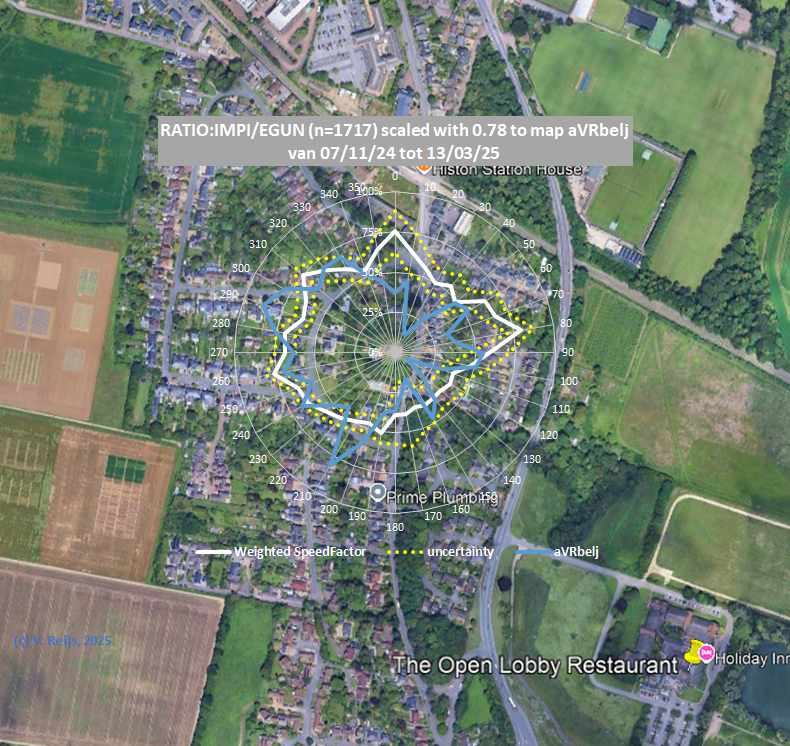
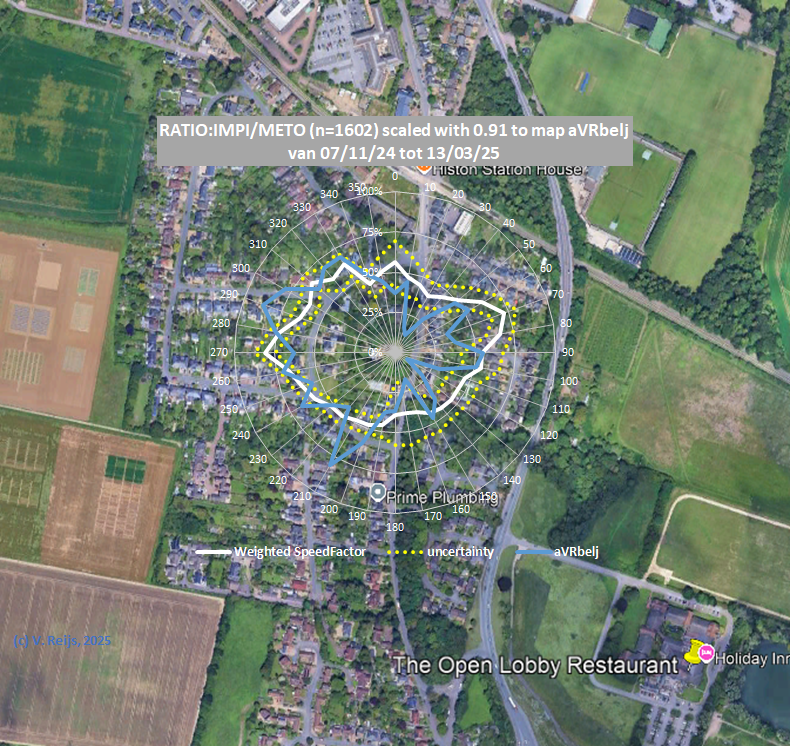
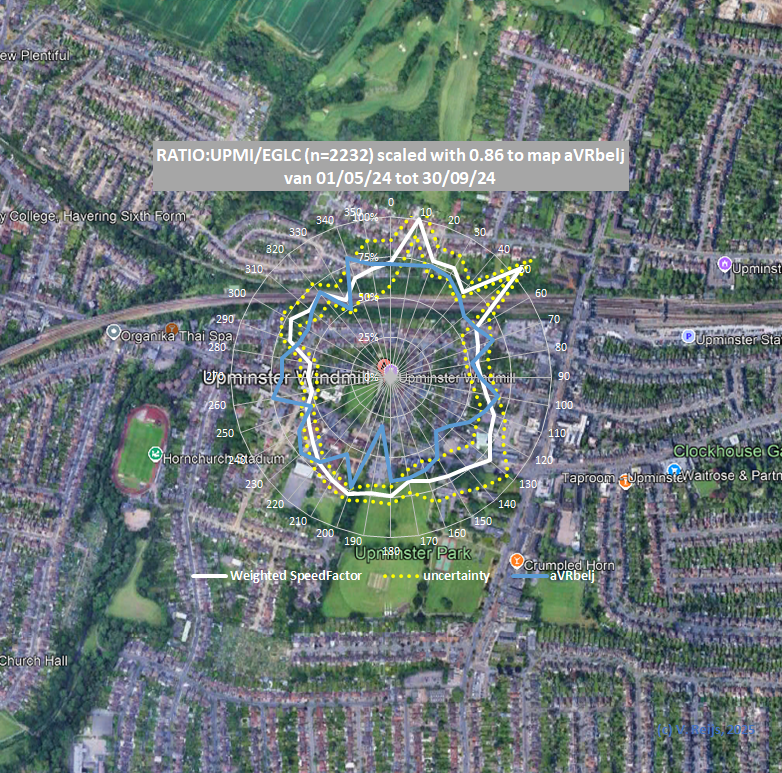
Checking the scaling factor at two other mills (Impington&Mildenhall,
Impington&Open-Meteo, Upminster&London City,
Upminster&Open-Meteo, and Labbus&Open-Meteo); one
gets a scaling factor between 68% to 108% (say around ~80%).Open-Meteo uses the the ECMWF-IFS 9km model.
z0a is being used within its weather models of Open
Meteo (pers.comm. Open-Meteo, 2025), see also. Remark: In below the z0m of mill and z0a of Meteo
have been set equal using
the value in this table.
The preferred period is May to
September, but in many cases not enough measurements were
available and then a larger period has been taken (Impington and
Labbus).
Impington&EGUN
Impington&Open-Meteo
Upminster&EGLC
Upminster&Open-Meteo
Labbus&Open-Meteo
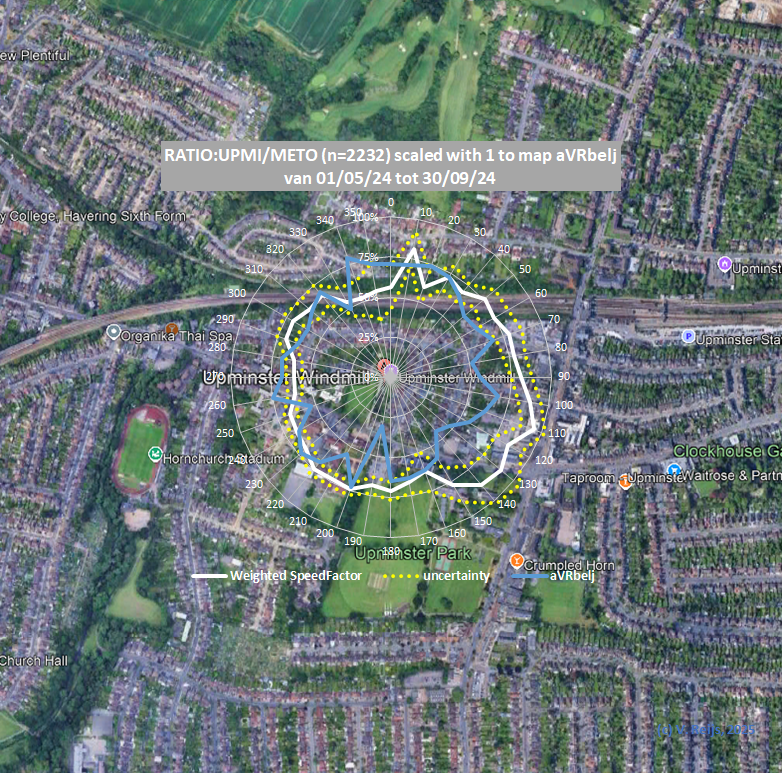
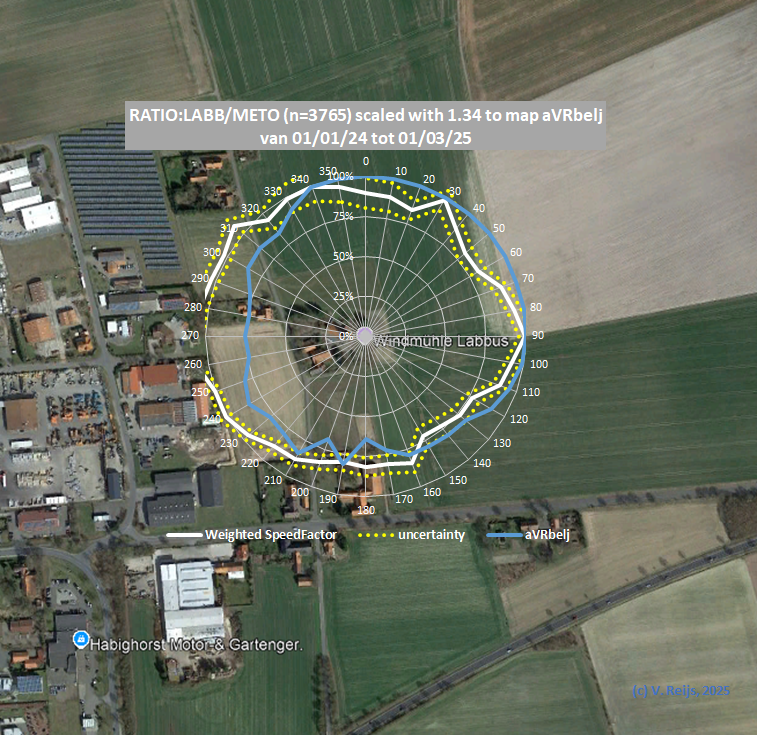
There are differences between measurements and
calculations, so needs to be understood why there is a
difference!!!!
For Impington: The anemometer is at the fan tail platform,
so slightly behind the cap, but don't think this can explain
this difference (as the scale factor would compensate this).
I also don't think that the nearby Western trees could
produce backpush for wind from the East (that would decrease
the windfactor of Eastern directions instead of increasing).
There could be wind channeling on the East (which would
increase the speedfactor as seen).
For Impington when looking at Open-Meteo the differences
are smaller with the calculations.
Could this be due to seasonal effects?
For Upminster: Both EGLC and
Open-Meteo compare not that well in the South-East with
the calculations.
For Labbus: the differences are
all around the speedfactor radar...
Remember there is a scale factor that mapped
speedfactor on the calculations.
The uncertainty (the yellow dots around the white curve)
of the Speedfactor can not really explain the differences.
The z0a has been calculated
(using a logarithmic ABL) from the wind speed at a
height of 10, 80, 120 and 180m derived from Open-Meteo Weather Forecast.
This gives the following data (the Latitude and
Longitude are Open-Meteo's grid points closest to the
Mill):
Mill
Open-Meteo
Latitude
Open-Meteo
Longitude
Environment
Open-Meteo point
z0a
Impington
52.24°
0.12°
quite open landscape,
400m from Impington
and Cambridge
0.65m
Labbus
52.68°
8.84°
just outside Sulingen
village
0.41m
Upminster
51.56°
0.24°
London suburb
0.93m
Some conclusions
We need to remember that a stable calibration of the magnetometer
has now happened for some 17 weeks (Nov. 8, 2024 to March 1,
2025). Longer averaging might change the results in the future. If
we need to have seasonal numbers, a two year period migth be
needed.
There were battery problems with one or two magnetometers between
21 January and 17 February 2025.
<more to be added>
I would like to thank people, such as Justin
Coombs, Camiel Damen and others for their help, encouragement
and/or constructive feedback. Any remaining errors in
methodology or results are my responsibility of course!!! If you
want to provide constructive feedback, please let me know.