Simulating the wind around a house
Simulating the wind
around a house by Victor Reijs
is licensed under CC BY-NC-SA 4.0


Introduction
These CFD tips are
being used.
This web page has the following sections:
Bold purple text needs attention.
Working in SketchUp
- Made a house of 10*10*9m (l*w*h). Included in the house height
can have a gable roof of 4m.
- The length of the house ranges from y=0m to y=10m.
- The width of the house ranges from x=-5m to x=5m.
-
block
|
wind
against gable
|
wind
along gable
|

|
 |
 |
- If finished: 'Save' en 'Download' -> 'STL'
- Effort: 0.5 hours
Editing 3D-model in SIMSCALE
The following steps are done:
- Import het STL
model
- Edit this model by: Edit a copy
- Make a Flow Volume ->
'External flow volume'.

- Delete the house
- Save
- Effort: 0.25 hours
Configuring the CFD
The model is at House.
The following steps were taken to derive the above Simulation
Runs (based on
CFD tips):
- Goto SIMULATIONS +
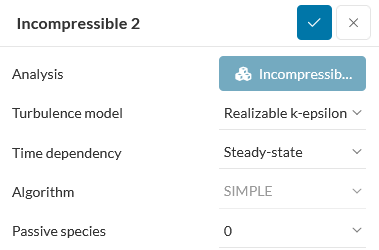
- Incompressible -> Turbulence-model -> Realizable
k-epsilon [Franke, 2007, page 14] [Franke, 2007, section
B.2.1 for PWC]
- Materials -> Air -> Apply
Assigned Volumes -> Flow region
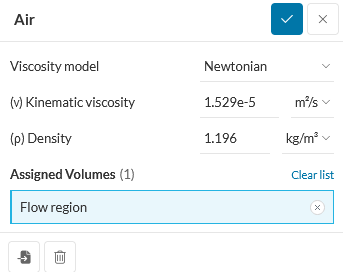
Remark: this is not the recommended temperature related air
parameters as in CFD tips. The above looks to be close to 22C
- Boundary conditions
- Velocity Inlet
Assigned Faces -> the wind side
(U) Velocity -> Uy -> ABL Formula
(7.09m/sec at 10m and z0=0.03m, the wind direction
is 180deg [S])
(0.41*7.09/log((10+0.03)/0.03))/0.41*log((z+0.03)/0.03)
Turbulence -> Fixed value
(k) Turb. kinetic energy -> ABL derived Formula
((0.41*7.09)/(log((10+0.03)/(0.03)))^2/(0.09)^0.5)
(ε) Dissipation rate -> ABL derived Formula
(0.41*7.09/log((10+0.03)/0.03))^3/(0.41)/(z+0.03)
Also z0 of 0.03m and 2m are being
tested.
Save

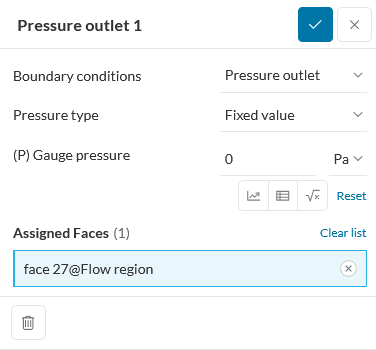
- Pressure outlet
Assigned Faces -> opposite inlet side
Save
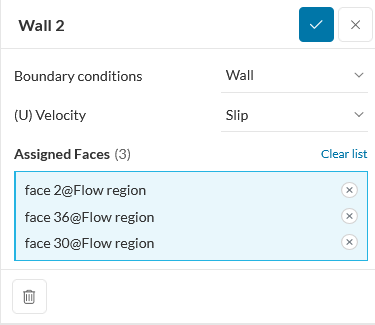
- Wall
Assigned Faces -> two sides and top
(U) Velocity -> Slip
Save
- Custom (ground)
Assigned Faces -> bottom side
Wall roughness -> On
Roughness height -> 5.44m (kS; 5.44m
(~11*z0), [Blocken, 2015, formula (15)]. as
SIMSCALE is based on OpenFOAM and Cs=0.9).
Also kS of 0.333 and 21.76m are tested
Remark: kS
should have been 0.33m
Roughness constant -> 0.9 (Cs)
Save

- Mesh

The resulting mesh cell size is on average around 0.9m.
- Mesh -> Refinements -> Inflate boundary layer
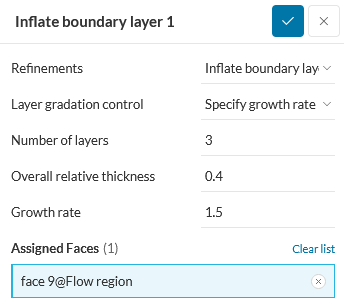
- Effort: 0.5 hour per house type
Running the CFD
- Simulation Runs +
- Three house types have been simulated:
- a block house
- a house with gable roof, wind against the gable
- a house with gable rood, wind along gable
- The speed in the y-direction (same as wind direction) has been
determined in the middle of the house (on the y-axis).
- A block house (z0=0.5m, ks=5.44m, and Inflate Boundary 0.4 relative
thickness of 0.9m = 0.36m)

There were some oscillations in the residues of the simulation.
- House with wind against gable roof (z0=0.5m, ks=5.44m,
and Inflate Boundary 0.4 relative thickness of 0.9m = 0.36m)

- House with wind along gable (z0=0.5m, ks=5.44m,
and Inflate Boundary 0.4 relative thickness of 0.9m = 0.36m)

- House with wind along gable (z0=0.03m, ks=0.333m,
and Inflate Boundary 0.4 relative thickness of 0.9m = 0.36m)

- House with wind along and against gable (z0=0.03m,
ks=0.33m, and First
Layer (mesh) Size = 2*ks = 0.66m)

Wind along gable:

Wind against gable:

- House with wind along gable (z0=2m, ks=21.76m,
and Inflate Boundary 0.4 relative thichness of 0.9m = 0.36m).
This ks is too big; the roughness height modelling is
not functioning well anymore:

- Effort: 0.5 human hours and some 11 CPU hours per house
Conclusions
- Nägeli
measured the wind speeds behind a Dichte Wand a
henge (H=2.2m, width of 11H, optical porosity of ~17.5%, and z0m
of 0.03m). One could compare these a little with the above
results of house with wind 'along gable' (H=10m, width of 1H,
optical poristy of 0%, and z0 of 0.03m).

With Nägeli: H=2.2m, thus 0.55m::0.25;
1.1m::0.5; 2.2m::1; 4.4m::2;
8.8m::4.
As the house (10m) is less wide than the 25m henge one would
expect a faster increase of the speed
for the house.
The dip seen in the curves happens closer to he end of the
obstacle if it is less porous. The rest of
the curves' forms looks similar (exponential).
Remark: Is this comparison/evaluation
between Nägeli and simulation correct?
- The curve z/H=0.25 can be higher than the z/H=0.5 and 1
curves; this can be seen in this houses' experiment and in
Nägeli's.
- For certain houses ('block' or high z0) the speed
at low heights (z/H = 0.25 and 0.5) are higher than the speed of
the ABL inlet. Simultaions by others also show this effect.
- The difference in speedfactor between 'House, along gable' and
'House, against gable' is some 15% (looks to be regardless of z0).
- After a house: Some kind of compression towards the ground or
increase of Turbulent Kinetic Energy (TKE below is of the House
with wind along gable [z0=2m,]).

The vertical line is at x/H=27.5, the lighter blue
the more TKE.
- For some reason it was not possible to reduce the mesh size
further than 0.9m (due to having not enough memory or
resources). This could provide problems when looking at the
absolute values, but hopefully one can compare the outcomes at
some level.
Remark: someone else will need to check
these house configurations with smaller mesh size; with the
aim to verify the results on this page.
- There is some residual instability for the House 'block'. The
other houses look ok-ish.
- The influence of looking at wind speed magnitude instead of
using windspeed(y) (same as inlet wind direction) is very small,
except near the house.
- The 'block' house and 'along gable roof' are similar. This
could be because the wind speed has been determined in the
middle of the house; along y-axis (where block and gable have
the same physical height).
- As it is not really known how a roof will be aligned with the
wind (depending on direction of wind and positioning of the
house); it is expected that the behavior of the roofed house
will be between 'against gable roof' and 'along gable roof'.
- As expected, the lower the z0 the longer it takes
before the speed is back to the inlet.
- If we assume no obstacles within the first 100m from the mill
(in above graphs this is at 11H); the curves could be seen as
exponential, but tending to be linear. If obstacles are within
this 100m, the exponential aspect becomes certainly important.
References
Acknowledgements
I would like to thank people, such as and others for their help, encouragement and/or
constructive feedback. Any remaining errors in methodology or
results are my responsibility of course!!! If you want to
provide constructive feedback, please let me know.
Major content related
changes: April, 20, 20245
-90
 Home
Home Up
Up Search
 Mail
Mail