Bardwell mill and a planning application
Bardwell mill and a planning application
by Victor Reijs
is licensed under CC BY-NC-SA 4.0


An application for housing estate
There is a planning application for an housing estate in
Bardwell, near Bardwell mill.
Evaluation application
A quick read through the document related to the mill has been done
(more tiem coudl be pent if wanted/neeed):
- page 5: important to read "adversely affected".
In American law this means:
Environmental & Property Law: An action that causes
identifiable harm or unreasonably interferes with the use,
enjoyment, or structural soundness of a property or natural
resource.
What is the meaning in UK law?
- Section 5: the interpretation of the plan looks to be correct,
when I read the proposal files myself.
- Section 6: for now I assumed the data and calculations of
Bardwell Mill are correct. They incorporated the change of z0
(roughness length).
- Section 7: Nageli measured two
configuration of fences: one called 'dichten Schilfwand'
and the other 'lockeren Schilfwand' (Bild 2, 1953):
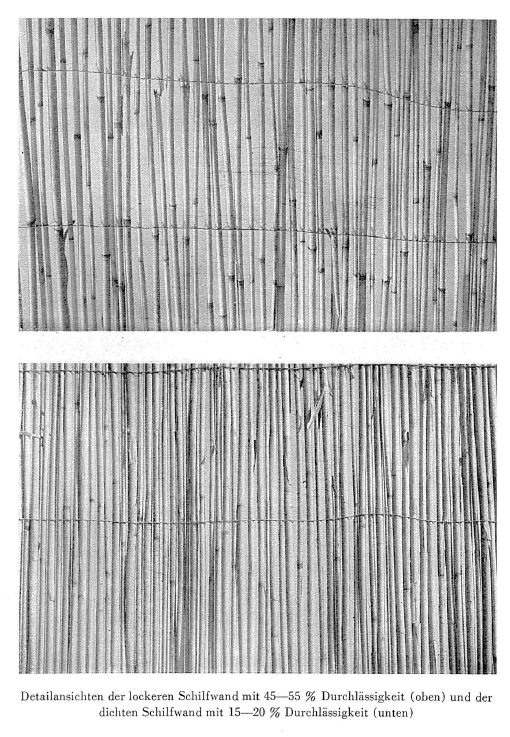
'Dicht Schilfwand' is thus not 'Solid' it has an optical
porosity of 15 - 20%!
This porosity of will change the
calculated wind behavoir behind the object.
- Section 9 (as mentioned in the text): I think that comparig
things should be done during daylight/working hours (or between
09:00 and 17:00) so not for 24h per day. The wind during night
time is normally lower (diurnal variation of the wind). This
will have impact on the (effective) milling hours.
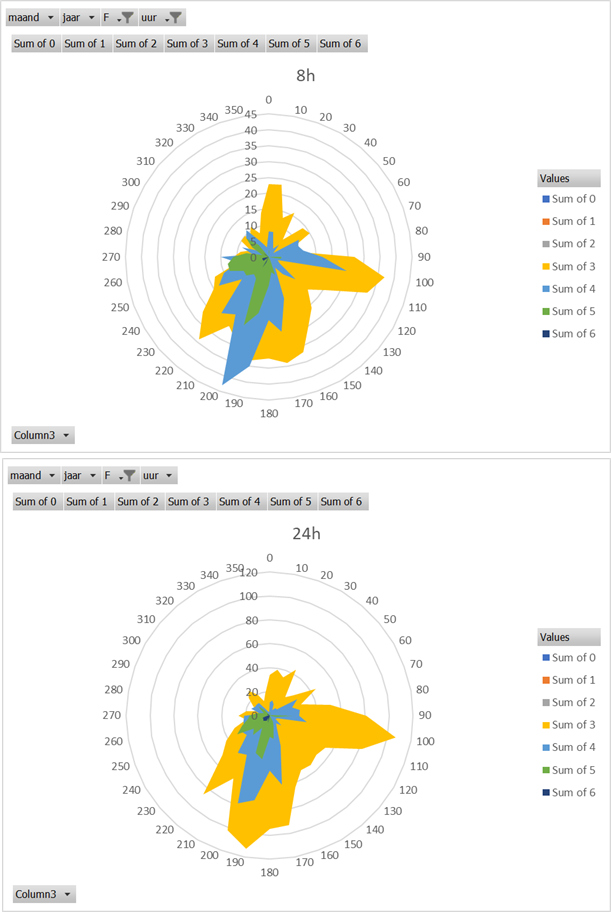
Here are windrose examples of a MET (KNMI-Cabauw) readings of a
station in an open environment (z0 ~ 0.05m) for 8h working day
or a 24h day:
- Please check first the influence of
this 'Dichte Schilfwand' issue and the daylight/working
hours.
- Section 10. So the question is, is an average 5% reduction in
speed (averaged over the whle windrose: which is 14% in energy)
an 'adversely affected" phenomenon? I would say yes, more than
10% energy is a lot.
- Section 10: I have not been able to find data about the trees
that will be planted as part of the development.
It is essential to know the green
planning in this development.
A tree (in fully leaved status and mature hieght) should be
evaluated as an obstacle (as solid or as poreus [say with an
optical porosity of 20%).
- The Dutch molenbiotoop method of The Hollansche Molen (https://www.molens.nl/sites/www.molens.nl/files/documenten/20220715_MEM_Biotoop%20Dossier%20Biotoopformule.pdf
and https://www.archaeocosmology.org/eng/DHMformula.htm
) says that nothing should be heigher than de lowest position of
sail tip within a cicrle of diameter of 100m.
This is mainly not because speed reduction, but due to higher
turbulence behind obstacles. As the development is certainly
100m to close the mill; this turbulence would badly effect the
effectivecy of the mill and it will give larger stesses on the
wings (and can cause over time metal fatigue).
- Here are the numbers when using the Dutch molenbiotoop method
(cross section plan of the devlopement is here):
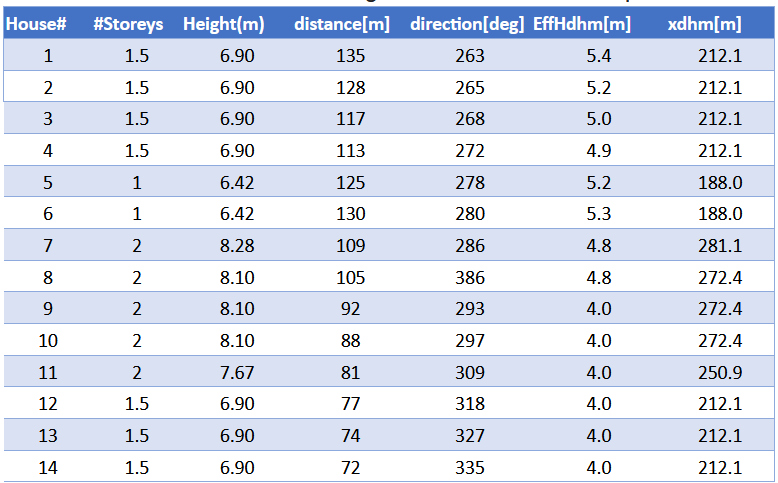
EffHdhm is maximum height (m) of a obstacle at that
present development distance. xdhm is the distance
(m) that the obstacle with a height in the development should be
placed.
And all xdhm
are for all proposed houses too large; so the proposed
houses should all be lower and/or more distant!!!
- A CFD of the
development migth be important, as it is a relatively
large development.
How to conduct a CFD for a traditional windmill biotope can be
seen here.
Quantification of speed reduction
The below speed reduction of the obstacles is based on several methedologies (e.g. Steve Temple,
the Dutch molenbiotoop formula, Evert-Jan Laméris' and my own
methods).
Before:
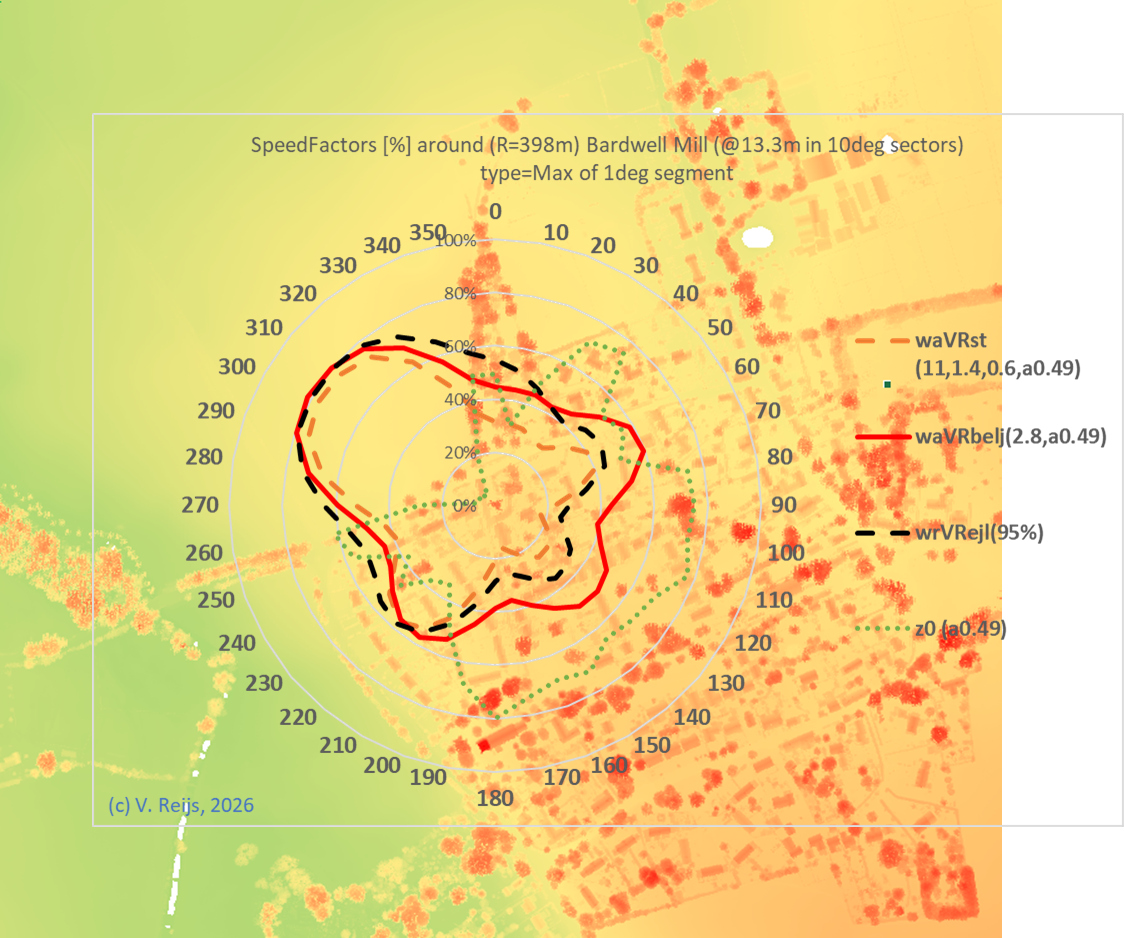
waVRst:
is a method based on Steve Temple's method
waVRbelj,
a method based on Beljaars' article (DHM formula is also based
on that article, but a more extensive Beljaars is used)
wrVRejl:
method based on Evert-Jan Lamaris' method.
z0
is based on clasifying (Davenport&Wieringa) the heigth and
distance between obstacles in DSM.
After:
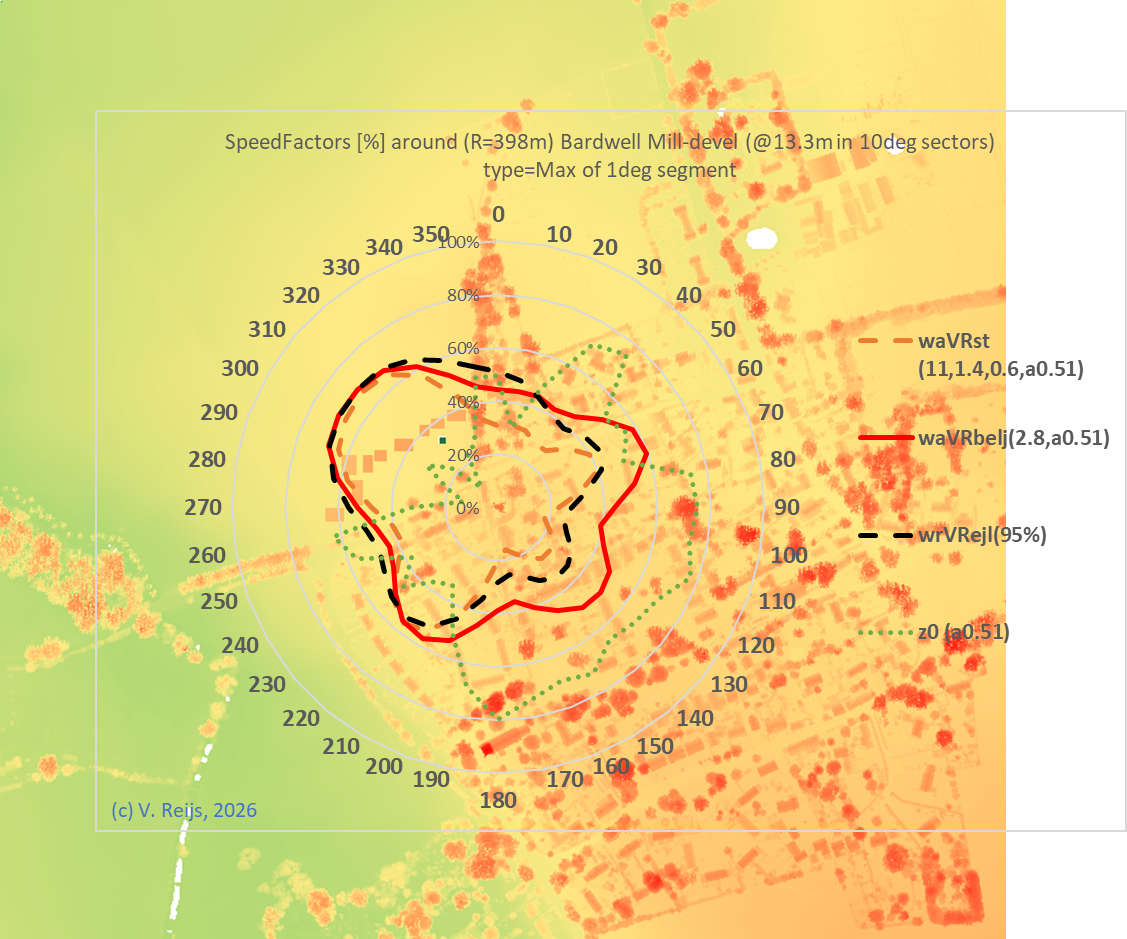
There is a 13% reduction in speed in the North-West region,
which is 33% in energy: so an 'adversely affected" phenomenon.
Conclusions
- Please check first the influence of
this 'Dichte Schilfwand' issue, the daylight/working hours
and green planning.
- It is essential to know the green
planning in this development.
- There is a 13% reduction in speed in
the North-West region due to this proposed developent: which
is 33% in energy. So an 'adversely affected" phenomenon.
- All max-house-heights (xdhm)
are too large; so the proposed houses should all be lower
and/or more distant!!!
- A CFD of the development migth be
important, as it is a relatively large development.
Acknowledgements
I would like to thank people, such as and others for their help, encouragement and/or
constructive feedback. Any remaining errors in methodology or
results are my responsibility of course!!! If you want to
provide constructive feedback, please let me know.
Major content related
changes: June 25, 2026
 Home
Home Up
Up Search
 Mail
Mail